
We have had some discussion related to the dissipation of heat from the Aptera in the past. One source of heat will come from the air conditioning condensers especially in the summer. Until I see the efficiency of the in body composite cooling, I still think we should have secondary ways to cool the car interior as well as heat from the motors/brakes when under heavy use. At this point, it is all theoretical and I haven't seen it used in anything else. Think going up a grade at 70 mph in ambient temperature of 95 degrees. I noticed that the Mustang GT has louvers that can maintain an aerodynamic body shape until extra cooling is required.
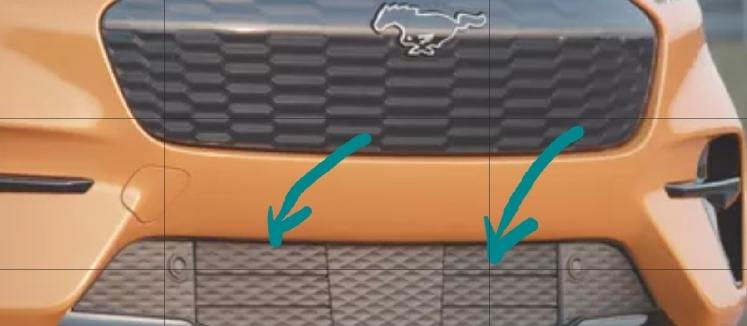
I still think an ideal location of a vertical oriented evaporator would be the front of the rear wheel enclosure where the air is normally stirred up by a rotating wheel/tire assembly. Alternatively, if the company wanted to keep an in-body design with a ducted air flow to a metal radiator or condenser at the underside of the body on either side of the third wheel assembly. Metal of either copper or aluminum has one of the best heat transfer characteristics and would be much better than that of composite. Minimal aerodynamic disturbance if NACA ducts are used. Air is ducted into an air flow, through an in-board radiator/condensor and out the rear flat panel adjacent to the license plate. We use these on both cars and planes anytime air needs to be ducted with a minimal surface air disturbance. Anyone who works with turbocharger intercoolers knows how hot air-conditioning evaporators get and knows to keep the intercooler in front of those structures. Just food for thought. We are all guessing until we see what production comes out with and the data associated with heat efficiency.

Hey N.Bruce. I am curious since I have never seen any plans or the actual composite of the body. Are these coolant channels going to be incorporated as tubing incorporated inside the composite, or on the inside surface of the body composite? I was also envisioning the channel within the main composite body similar to what we see as a cross section of corrugated cardboard. What layer will have these channels? Near the inner or outer surface. Will any metal sheeting be used to augment the conduction? Thanks.
Body color will not have much effect on the Aptera interior temperature. All things being equal black is both more efficient at adsorbing heat and at radiating it. Color doesn't have much effect on convection, which is how most of the the heat is transferred. Radiator is something of a misnomer in this deer.Also, the interior of the passenger compartment is far better insulated than the typical metal skinned car.
How much of an effect will the body color have on heat dissipation? Will the flow of coolant through the body affect the interior temperature of the vehicle?
Cooling a vehicle only takes a fraction of the energy (and thus waste heat) as moving a vehicle. So if it can travel at top speed (over 100 mph) in 125 degree heat and keep cool, I'm confidant it can keep its cool just sitting there, emitting a fraction of that heat energy. (Cooling skin is also on the bottom oof the car, which is always out of the sun.)
However, that's all to be tested this summer. Perhaps on a road trip to Death Valley? Luckily with 3D printing technology, they can quickly build a modified design if their 1st iteration falls short.
Are there any concerns when the air is not moving and trying to cool? (Waiting in an unshaded parking lot for a long time on a hot day) What would the effective cooling be over time as the body radiates heat back into the car trying to be cooled? Are there any concerns in medium cold -- how would it deal with falling slush on a cold body would turn into ice and stick to the body. Would there be a periodic defrost cycle for the ice to fall off?
good to hear from you. I agree that the radiator material would be sized according to its surface area and heat transfer capability. As you know aluminum and copper make excellent materials. Finned coils significantly increases the surface area and keeps the device compact. I think this need will be compounded more by those who had shown a desire to tow a small camping trailer or load with cargo.
Just a couple of points. 20 years ago when i was doing thermal modeling for the design of refrigeration systems, I had customers who fully instrumented their boxes and collected the energy use data. They would occasionally call me and tell me that their results over several years almost exactly matched my calculations. As a result, I have a lot of trust in the models, even from decades ago. Thermal conductivity of a condenser is only one factor in performance. Surface area and temperature differential are much more important, and Aptera will have a lot of surface area. Chris Anthony had this to say in answer to a question on hill climb response in hot weather: Chris, I was wondering if long steady grades at high speed in hot weather would cause too much heat buildup for the cooling capacity of the wheel motors? How would would the car respond if this is a possibility? Would we get a notice to reduce speed?
Chris Anthony
CEO
Dec 29, 2020
2
Thanks for the question. We are designing to a 6% grade @ 65mph for 10mins in 110f heat. But we expect to have a comfortable safety factor in that. If the grade is steeper or if it's much hotter then the system would just cut back to reduce the heat and you'd lose a bit of power. We don't know exactly what the cut back will be until we do more testing but that's how it works ;) Thanks for your support!